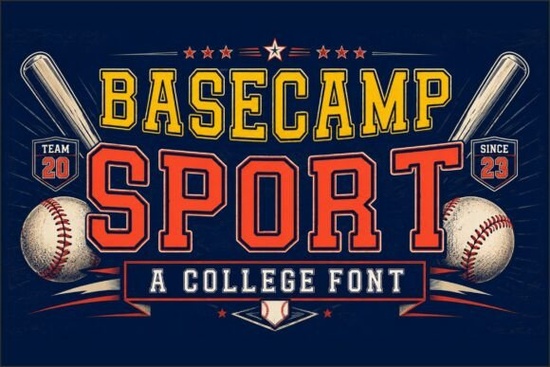
If you're designing sports logos, team merch, or vintage athletic posters, the Basecamp Sport Font is a straightforward choice for that bold, collegiate look no overcomplicating needed. It’s a slab serif with strong serifs, layered outlines, and clear sporty energy think baseball jackets, varsity lettering, and retro gym badges. You don’t need design experience to use it well: uppercase-only, intuitive spacing, and built-in outline compatibility make it easy to layer, cut, or print right away.
When does Basecamp Sport work best?
This font shines where clarity, impact, and nostalgia matter most especially for physical products and branding that need to read well at a glance. It’s not meant for body text or long paragraphs. Instead, it fits naturally in contexts like:
- T-shirt and hoodie designs (front chest logos, back prints)
- Team branding kits logos, banners, digital social headers
- Print-on-demand items: mugs, tote bags, caps, stickers
- Vintage-style posters, event flyers, or school spirit materials
- Badge-style graphics (e.g., “TEAM CAPTAIN”, “VARSITY 2024”)
Because it includes numbers and standard punctuation and is designed with clean vector outlines it scales cleanly from small iron-on transfers to large wall decals. Many users pair it with simple sans-serif fonts for contrast, or stack letters manually to build layered badges without extra plugins.
How does it compare to other slab serifs?
Slab serif fonts are popular for sporty, confident, and grounded visuals but not all behave the same way in real projects. Basecamp Sport stands out for its intentional “athletic weight”: thicker strokes, tighter spacing, and a slightly condensed feel that reads well even on curved surfaces like sleeves or hats. It’s less ornate than some retro display fonts, so it avoids looking dated or gimmicky.
For designers who also like clean, versatile slab serifs, Laveto is another solid option more neutral and slightly more refined, with lowercase support and subtle curves. It works well for branding that balances sportiness with professionalism (like youth league websites or local gym signage). Basecamp Sport leans harder into tradition; Laveto offers flexibility across more contexts.
What do crafters and POD sellers actually do with it?
Real-world usage tends to be practical and repeatable. One Etsy seller told us they use Basecamp Sport as their go-to for baseball-themed SVG bundles paired with basic star shapes and stitched borders, it cuts cleanly on Cricut and Silhouette machines. Another small business owner uses it for seasonal high school spirit packs: football in August, basketball in January, track & field in spring same font, different colors and icons.
A few consistent tips from users:
- Always convert to outlines before sending to print or cutting software this avoids font substitution issues.
- Use the layered style intentionally: duplicate the text, offset slightly, and change color to create a “stitched” or “embroidered” effect.
- For t-shirts, test at 3–4 inches wide on mockups the font holds up well at smaller sizes, but avoid going under 2.5 inches for readability.
- It pairs easily with free Google Fonts like Montserrat or Open Sans for supporting text (e.g., taglines or disclaimers).
Is it beginner-friendly?
Yes if your goal is a bold, recognizable sports look, you’ll get results fast. There’s no learning curve around alternates, ligatures, or stylistic sets. What you see is what you get: uppercase letters, numbers, and common punctuation, all optimized for visibility. No hidden features, no trial-and-error required.
That said, if you’re working on a project that needs lowercase, script accents, or multilingual support (like Spanish accents), this isn’t the font for that job. It’s focused not flexible and that focus is part of why it works so well for its niche.
For reference, you can view the full version of Basecamp Sport Font and Laveto Font directly on Creative Fabrica.
Before you download: Check your software compatibility (it’s a standard OTF/TTF), save a backup copy, and try one layout first on a mockup or scrap fabric before scaling to full production.
Explore Design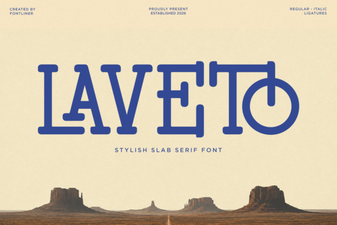 Laveto Font: Modern Design for Creative Projects
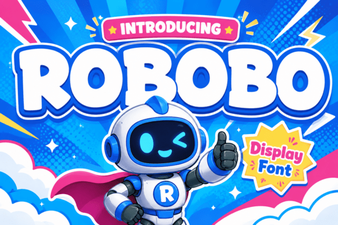 Robobo: a Modern Font for Digital Projects
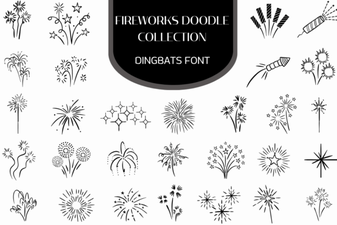 Spark Your Projects with Firework Doodle Fonts
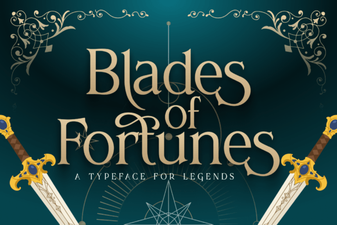 Designing Fortunes: a Font for Blade Themed Projects
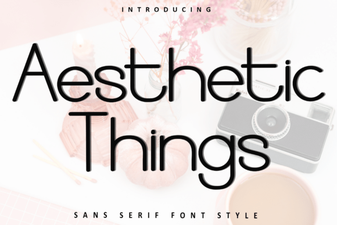 Fonts That Make Your Designs More Beautiful
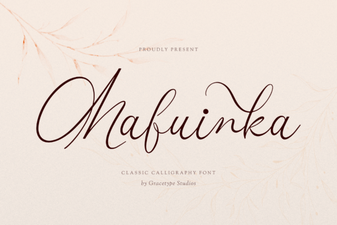 Mafuinka Font: Creative Typography for Your Projects